
Secondary publishing is the mechanism that allows mugshots to spread far beyond the original arrest.
In mugshot publishing, secondary publishing refers to the reuse, republication, or redistribution of police booking photos and arrest details by websites that did not originally create or capture that content. In legal terms, secondary publishers are distinguished from the creators of the law and may refer to subordinate distributors.
Is your mugshot or arrest record still online?
Get a Free Case ReviewThese secondary publishers obtain mugshots from public records, law enforcement agencies, county jail feeds, or news media, then republish them on independent websites. Secondary publishers do not publish original research; instead, they organize material produced by primary publishers.
Secondary publishing is why mugshots appear on dozens of sites, rank repeatedly in Google search results, and remain visible long after an arrest has no legal outcome.
How Secondary Publishing Works for Mugshots
Secondary publishing follows a predictable pattern.
- Law enforcement agencies release booking photos or arrest records
- Mugshots are considered public records in many jurisdictions
- Secondary publishers collect and repost that content
- Mugshots are indexed by search engines
- Web traffic increases through repetition and scale
Most mugshot websites rely almost entirely on secondary publishing rather than original reporting. They republish content created elsewhere.
This distinction matters legally.
Why Secondary Publishing Is Central to Mugshot Websites
Mugshot websites exist because secondary publishing enables them.
Without secondary publishing:
- Mugshots would appear once, not everywhere
- Arrest photos would expire with news cycles
- Search results would not be dominated by booking photos
Secondary publishing turns a single police booking photo into permanent internet content.
That permanence is where legal, ethical, and reputational harm begins.
What Access Secondary Publishing Allows Under Public Records Law
Secondary publishing of mugshots is often justified by public records access laws.
In many states, police booking photos are:
- Considered public records
- Accessible through county jail databases
- Released under the freedom of information statutes
However, public record status does not grant unlimited reuse rights.
Courts have repeatedly held that secondary publishing can still:
- Cause reputational harm
- Create a presumption of guilt
- Violate constitutional protections for pretrial detainees
What Secondary Publishers Are Allowed to Reuse
Secondary publishing allows limited reuse under strict conditions.
Allowed uses typically include:
- Republishing booking photos tied to active criminal charges
- Displaying arrest information accurately
- Linking images to verifiable public records
- Updating content when case outcomes change
Secondary publishers must distinguish clearly between:
- Arrest and conviction
- Accused and guilty
- Charged and found innocent
Failure to do so has resulted in lawsuits.
Types of Reusable Content
In academic publishing, reusable content plays a pivotal role in supporting educators as they create and share high-quality resources with students. This content spans a variety of key areas, including literacy, reading comprehension, math exercises, science experiments, and social studies activities. By leveraging reusable content, educators can efficiently develop teaching materials that address diverse classroom needs and curriculum standards.
Reusable content empowers teachers to focus on building essential skills and introducing innovative tools that enhance both teaching and learning experiences. Whether adapting a reading passage for different grade levels or customizing math problems to align with specific learning objectives, educators can meet the unique needs of their students. The flexibility to create and adapt content ensures that classrooms remain dynamic and responsive to educational needs, ultimately enriching the overall educational experience.
Licensing and Permissions
Understanding licensing and permissions is essential for educators and authors who wish to access and share educational resources responsibly. Licensing terms define how content can be used, modified, and distributed, ensuring that both legal and ethical standards are upheld. Many publishers, committed to supporting education and innovation, offer a range of flexible licensing options—such as Creative Commons licenses or direct agreements—that make it easier for educators to access a wide selection of titles and materials.
By being mindful of licensing requirements, educators can confidently incorporate high-quality resources into their teaching, collaborate with peers, and contribute to a culture of sharing within the academic community. Clear permissions not only protect the rights of content creators and authors but also foster an environment where educational content can be widely accessed and utilized to enhance learning outcomes.
Reuse Guidelines
To maximize the benefits of content reuse in education, educators should follow established guidelines and best practices. These guidelines often include properly citing original authors, adhering to licensing terms, and thoughtfully adapting materials to fit specific curriculum goals. By doing so, educators help maintain the integrity and quality of the resources they use, while also encouraging a culture of collaboration and respect within the academic community.
Guidelines for reuse are developed in partnership with scholars and educators, ensuring they are relevant and practical for today’s classrooms. As technology continues to shape how we teach and learn, these guidelines help foster engagement, inspire innovative teaching methods, and support the creation of adaptable resources that meet students’ evolving needs. By following these principles, educators can create, adapt, and share content that not only meets curriculum requirements but also drives student success and academic achievement.
What Secondary Publishing Does NOT Allow
Secondary publishing does not allow:
- Charging removal fees
- Republishing expunged or sealed records
- Publishing mugshots solely to generate web traffic
- Implying guilt where no conviction exists
- Ignoring case dismissals or acquittals
Many mugshot sites violate these limits.
As a result, the mugshot publishing industry has been labeled an online extortion scheme by legal scholars and the American Bar Association.
Secondary Publishing and Mugshot Removal Fees
Secondary publishing is directly tied to mugshot extortion.
Many secondary publishers:
- Republish booking photos
- Rank them aggressively in Google
- Demand hundreds or thousands of dollars for removal
At least 35 states have introduced or passed laws banning removal fees or requiring mandatory takedowns.
Secondary publishing is now a regulated activity in multiple jurisdictions.
State Laws Limiting Secondary Publishing of Mugshots
Several states have outright restricted secondary publishing.
Examples include:
- New York is banning mugshot release unless it serves law enforcement needs
- California is prohibiting police from posting mugshots on social media
- Utah is banning mugshot publication until after conviction
- South Carolina is limiting nonviolent arrest photos
These laws directly target secondary publishers, not the police.
Why Secondary Publishing Creates Lasting Harm
Secondary publishing multiplies harm.
Once a mugshot is republished:
- It appears across dozens of websites
- It becomes permanently indexed
- It follows individuals for years
- It affects jobs, housing, and relationships
Studies show that having a criminal record — even without a conviction — can cut employment opportunities in half. Secondary publishing magnifies that damage.
Racial Impact of Secondary Publishing
Secondary publishing disproportionately affects Black people.
Research shows that mugshot websites:
- Overrepresent Black individuals
- Reinforce racial bias in search results
- Create distorted perceptions of crime
Because secondary publishers rarely remove content voluntarily, these disparities persist indefinitely.
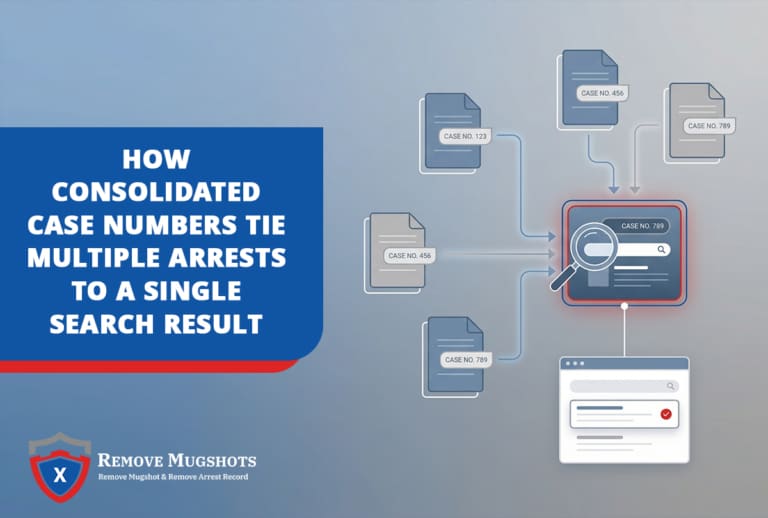
Why Case Numbers Matter in Secondary Publishing
Names are unreliable. Case numbers are not.
Secondary publishing that relies on names alone leads to:
- Misidentification
- Publishing the wrong person
- Increased legal exposure
Case numbers allow secondary publishers to:
- Verify records
- Track case outcomes
- Remove mugshots when required
Courts increasingly treat failure to verify as negligence.
Law Enforcement Is Reducing Mugshot Releases
Law enforcement agencies are pulling back.
The U.S. Justice Department has refused to release mugshots, stating there is no public safety interest. Many police departments now delay or restrict release entirely.
Secondary publishing has continued even as law enforcement retreats.
What Responsible Secondary Publishing Looks Like
Responsible secondary publishing is possible, but rare.
It requires:
- Verification before republication
- Case-number tracking
- Removal after dismissal or expungement
- No removal fees
- Clear legal context
Most mugshot sites fail this standard.
Why Secondary Publishing Research Is Under Legal Scrutiny
Secondary publishing is no longer viewed as neutral distribution.
Lawmakers, judges, journalists, and law enforcement agencies increasingly recognize that secondary publishing:
- Shapes reputations
- Distorts search results
- Causes measurable harm
The era of unchecked secondary publishing of mugshots is ending.