
How Consolidated Case Numbers Tie Multiple Arrests to a Single Search Result
March 25, 2026 Legal Tips | Uncategorized
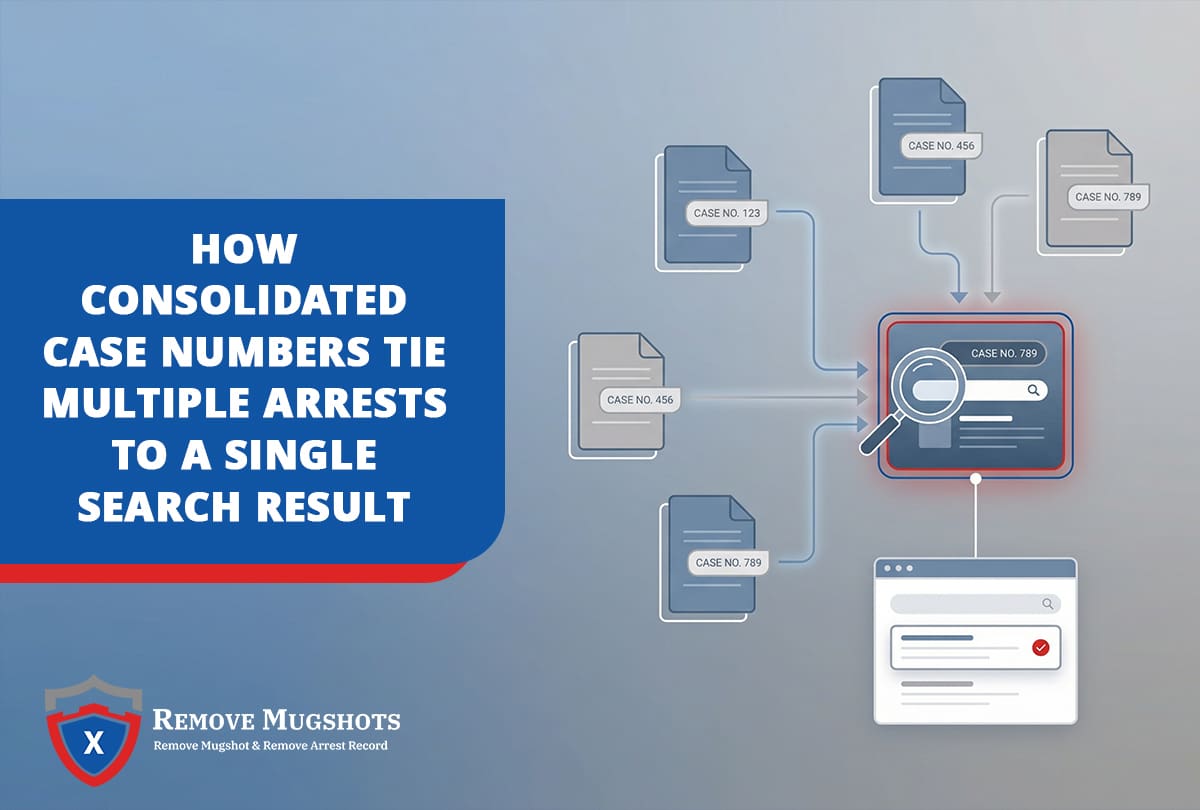
You run a background check and see one arrest. But behind that single result, three more arrests may be hidden—all tied to the same consolidated case number.
This isn’t an error. It’s how the system works. And if you don’t understand it, you can misread criminal records in ways that affect hiring decisions, expungement filings, or court reviews.
Here’s what you need to know.
What Is a Consolidated Case Number?
A consolidated case number is a single identifier that courts assign when multiple related arrests or charges are combined into a single case file.
Under Code of Civil Procedure Section 1048(a), courts can issue a consolidation order when separate cases share the same facts, the same transaction, or a common legal question. Instead of managing five separate case files for five co-defendants, the court designates one lead case. All related records link to it.
This isn’t just administrative convenience. It shapes how records appear in public databases, how background checks display arrest history, and how defendants are prosecuted together.
A Real Example: How Multiple Arrests Become One Case
In Rapid City, a routine traffic stop led to something much larger.
Officers pulled over a vehicle after noticing a license plate violation. That stop led to the arrest of two local residents. Detectives found methamphetamine, fentanyl, firearm parts—including handgun slides and a ghost gun jig used to manufacture unserialized firearms.
Ian Brower was charged with possession of methamphetamine and fentanyl with the intent to sell. Che Brower was charged with manufacturing firearms and possession of methamphetamine with intent to sell. Both were taken into custody.
In a separate operation, the Carson City Sheriff’s Office Special Enforcement Team and SWAT conducted a coordinated bust involving electronic and physical surveillance. A search warrant executed at a residence resulted in multiple arrests for drug trafficking and illegal firearm manufacturing. Gabriel Brown and Jennifer Wolfe were among those taken to the Pennington County Jail.
These are exactly the scenarios where consolidated case numbers come into play. Multiple individuals arrested together are considered co-defendants and face joint legal proceedings. Their arrests—though separate events—are linked under a single case number.
Why Courts Consolidate Cases
Courts consolidate cases for one primary reason: efficiency.
When multiple defendants face charges from the same controlled substance operation, the same conspiracy, or the same criminal enterprise, running separate trials wastes time and money. Witnesses would testify multiple times. Judges would repeatedly review the same evidence. Juries would hear overlapping facts.
Consolidation solves this. The court combines the cases, assigns a lead case number, and manages everything under a single file. This is common in:
- Drug trafficking cases — arrests from a single bust involving meth, fentanyl, or other controlled substances
- Conspiracy charges — individuals charged with crimes they did not commit physically but were part of a shared scheme
- Illegal firearm manufacturing — co-defendants charged with possession of weapon components like ghost gun jigs or unregistered handgun slides
- White collar crime — fraud cases involving executives acting within the same enterprise
- Mass arrests — situations during raids, protests, or escalated traffic stops where police arrest multiple individuals at once
Mass arrests typically happen when law enforcement deems a situation an unlawful assembly, or when a single operation—like a drug raid—leads to multiple simultaneous arrests. Officers separate co-defendants during booking to prevent them from coordinating stories.
How This Affects What You See in a Database
When you search a public records database, the system returns results based on case numbers, not individual arrest events.
The FBI’s Uniform Crime Reporting (UCR) Program counts one arrest for each separate instance in which a person is arrested, cited, or summoned for an offense. But the UCR arrest figures do not reflect the number of individuals arrested—they reflect the number of arrest instances. That’s an important distinction.
Expanded UCR data includes information about the age, gender, race, and ethnicity of arrestees. But it doesn’t always show that three arrests are buried under a single consolidated number.
When a database links consolidated cases, it uses search algorithms that match:
- Shared defendant names
- Same arrest dates or incident locations
- Overlapping charges (e.g., possession of a controlled substance, drug paraphernalia, or firearm offenses)
- Common case identifiers tied to the same traffic stop or search warrant
So a search might surface one result. Click into it, and you may find multiple arrests, multiple defendants, and multiple charges—all from the same operation.
The Legal Complications Behind One Case Number
Consolidated cases aren’t simple. They create real legal tension.
Conflict of interest
Defendants often cannot share the same lawyer because their interests may diverge. One co-defendant may cooperate with prosecutors. Another may not. That conflict prevents joint representation.
The Bruton Rule
If one defendant made a statement implicating another, that statement can only be used at trial if the person who made it testifies. This creates complications in joint trials and sometimes leads courts to order a separate trial for specific defendants.
Charge stacking
Prosecutors may file multiple charges for a single criminal act. A driver arrested during a traffic stop may face charges for possession of methamphetamine, possession of drug paraphernalia, a weapon-related violation, and conspiracy—all from one stop. This is sometimes called “charge stacking,” and it’s a deliberate prosecutorial strategy.
Package deal plea bargains
Prosecutors may offer deals that pressure all defendants to plead guilty to lesser charges. This is sometimes called a “package deal.” Refusing can mean harsher sentencing if convicted at trial—a dynamic critics call the “trial penalty.”
Double jeopardy
If pending cases overlap in the same transaction, defendants may raise double jeopardy concerns. Courts must carefully evaluate how charges are structured before proceeding.
These aren’t abstract legal theories. They play out in real cases—including drug manufacturing operations, controlled substance trafficking networks, and multi-defendant conspiracies.
What This Means for Background Checks
A background check that yields a single result may not tell the full story.
One consolidated case number can hide multiple arrests. An employer who sees “one arrest” may not realize it represents a three-defendant drug-trafficking operation in which the individual played a minor role.
On the other side, a person trying to expunge their record may not realize that their single-entry result is tied to a broader consolidated case. Expungement requires addressing the entire merged record—not just one line item.
If you’re reviewing a background check:
- Look for consolidated case numbers and trace what arrests are linked to them
- Check whether charges stem from the same incident or different ones
- Verify through court records, not just background check summaries
If you’re trying to expunge a record:
- Identify whether your arrest is part of a consolidated case
- Any motion for expungement may need to address the full scope of the merged case
- Get legal advice before filing—consolidated records are more complex to clear
How to Search Consolidated Cases Effectively
Public databases like PACER (for federal cases) and state court portals allow you to search by case number, defendant name, or incident details.
To find consolidated records:
- Start with the defendant’s full name and date of birth
- Note the arrest date and location—this helps match co-defendant filings
- Search for any lead case designation linked to that arrest
- Review consolidation orders or transfer orders within the case file
- Look for related case notices that indicate other arrests were merged into the same number
Some databases have security verification steps to protect against automated scraping. If you get an error message or a “please try again later” prompt, that’s typically bot protection—not a sign the record doesn’t exist.
Common Misconceptions
“Multiple arrests under one case number means more guilt.”
Not necessarily. Consolidation is a case management tool. It doesn’t mean every defendant is equally culpable. A person present during a drug operation may be charged even if they had no direct role—charged as part of a conspiracy, not for the physical act itself.
“One result means one arrest.”
Wrong. A single search result tied to a consolidated number can include multiple arrests, multiple defendants, and multiple charges from the same event.
“Consolidated means everything is the same.”
Courts can limit consolidation to the trial phase only. Some evidence may apply to one defendant but not another. Separate sentencing often still occurs even when the trial is joint.
The Bottom Line
Consolidated case numbers are a normal part of how courts manage complex, multi-defendant cases—especially those involving drug trafficking, controlled substance possession, illegal firearm manufacturing, and conspiracy.
But they create real blind spots in public records searches. One result can mask several arrests. One case number can link a routine traffic stop to a large-scale operation involving meth, fentanyl, ghost guns, and multiple individuals.
If you’re researching criminal records—for yourself or someone else—don’t stop at the surface result. Pull the full case file. Check for consolidation orders. Understand what’s actually behind that single number.
The record is rarely as simple as it looks.
Share This Story


Fast Removal