If you were arrested, your mugshot may still appear in search results years later, even if charges were dismissed or you were never found guilty. Many people assume the court updates everything once a case ends. That is not how the system works.
Court records may change. Mugshot websites usually do not.
Is your mugshot or arrest record still online?
Get a Free Case ReviewUnderstanding why requires examining how public records, law enforcement agencies, and mugshot publishers operate separately within the justice system.
The Core Problem: Courts and Mugshot Publishers Are Not Connected
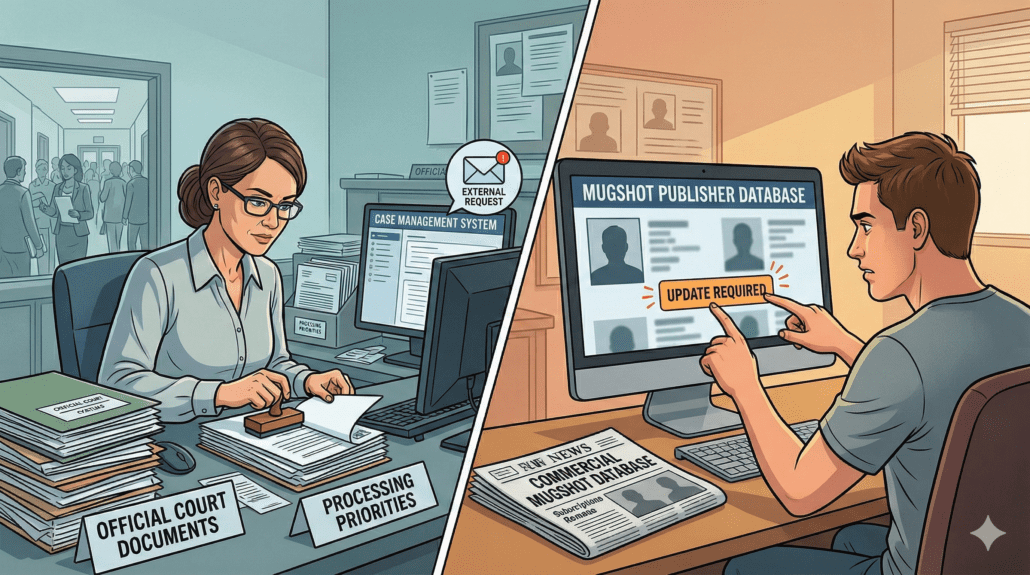
Court clerks manage official court records. Mugshot publishers run private websites.
There is no automatic system linking the two.
When a person is arrested, police booking photos become part of the public record. Law enforcement agencies often release these photos to media outlets and local journalism organizations as part of routine crime reporting. Once released, those pictures can be copied, republished, and indexed across dozens of websites.
After that point, courts have no control over where the images appear.
Even if charges are dismissed, the court updates only its own records. Clerks do not contact every website that decided to publish mugshots.
What Court Clerks Actually Do
Court clerks work inside the justice system. Their job is administrative, not investigative.
They:
- record filings from prosecutors and defense attorneys
- document hearings before a judge or jury
- update case outcomes such as conviction, dismissal, or sentencing
- maintain access to official public record databases
They do not monitor the internet.
Once police booking photos leave law enforcement systems and appear online, clerks are not responsible for tracking publication or requesting removal.
Their responsibility ends with maintaining accurate court files.
How Mugshots Become Public in the First Place
Many law enforcement agencies publish mugshots as part of transparency policies. Police departments may post photos on a website, share them with local news reporters, or release them in response to public records requests.
Historically, this supported crime reporting and community awareness.
But in the digital age, publication works differently.
A single arrest photo can quickly spread across:
- local news articles
- mugshot publisher databases
- aggregation websites
- search engine results pages
Mugshot publishers rely on arrest data and booking details supplied by law enforcement. They automatically collect photos and publish them, regardless of whether a suspect is later convicted.
Mugshots are posted at the moment of arrest, not after guilt is decided.
Why Court Clerks Don’t Send Updates
There are three main reasons.
1. No Legal Requirement
Open records law allows access to arrest information but does not require courts to notify private companies when case outcomes change.
Clerks update the court record. That fulfills their legal duty.
They are not obligated to issue removal requests or corrections to outside websites.
2. Resource Limits
Courts process thousands of cases each week. Tracking every website that publishes mugshots would require monitoring the entire internet.
Most clerk offices operate with limited staff and outdated systems. Their priority is maintaining court operations, not managing online reputation issues.
3. Legal Risk and Neutrality
Courts must remain neutral.
If clerks selectively contacted publishers, they could be accused of interfering with journalism or restricting lawful publication. Because mugshots are public records, courts avoid involvement once information is released.
Why Mugshots Stay Online After Charges Are Dismissed
This is the part many people misunderstand.
A mugshot remains online because the website—not the court—controls it.
Many mugshot publishers refuse removal even when:
- charges were dropped
- a person was found not guilty
- records were expunged
- the case never reached a conviction
Their business model depends on traffic generated by crime-related search results.
Critics argue some sites function as public shaming platforms or online extortion schemes, especially when companies demand payment for removal. Operators of several large mugshot websites have faced criminal charges tied to these practices.
The Real-World Impact
Publishing mugshots before a conviction undermines the presumption of innocence.
Research shows widespread mugshot publication can create an illusory correlation, causing viewers to associate certain groups with crime even when individuals were never found guilty.
The consequences are practical and immediate:
- job applications rejected
- housing opportunities lost
- personal relationships affected
- long-term reputation damage
Mugshot pages often appear during routine online searches for employment or background checks. Even one arrest can follow a person for years.
Why Lawsuits Are Difficult
Because mugshots are public records, lawsuits against publication are hard to win.
Courts generally protect lawful access to public information. However, attitudes are changing. In 2016, the Sixth Circuit Court of Appeals ruled that individuals have a meaningful privacy interest in booking photos, signaling growing concern about permanent online exposure.
Laws Beginning to Change the Industry
Several states now regulate mugshot publishers.
Examples include:
- California prohibits police from posting mugshots on social media.
- Utah restricts publishing mugshots before conviction.
- Georgia requires removal after a valid written request under specific conditions.
- In Florida, Arizona, and Georgia, websites are barred from charging removal fees in many cases.
Some legislation requires websites to remove images if a person was not convicted.
These laws recognize the reputational harm caused when arrest photos remain online indefinitely.
Why News Organizations Are Changing Too
Many newspapers and local journalism outlets have stopped publishing mugshot galleries altogether.
Editors increasingly question whether publishing mugshots serves public safety or simply generates clicks. Ethical concerns and community impact have pushed parts of the media industry away from routine mugshot publication.
Even many law enforcement agencies now question whether releasing booking photos is necessary.
What You Can Actually Do Instead
Since court clerks will not update mugshot publishers, action usually falls on the individual.
Send a Written Request
Many websites require a written request for removal. Include:
- case number
- court outcome documentation
- proof charges were dismissed or expunged
- contact information
Some sites offer free images with proper documentation. Others may refuse.
Use State Protections
If you live in a state with mugshot legislation, reference the law directly in your removal request. Failure to comply may constitute a violation.
Monitor Search Results
Even after removal, copies may appear elsewhere. Monitoring search results helps identify reposted photos early.
Why the System Works This Way
The gap exists because three systems operate independently:
- Law enforcement releases booking photos.
- Courts manage legal outcomes.
- Mugshot publishers run private businesses.
No single authority controls all three.
Court clerks are not ignoring updates. Their role simply never included managing third-party publication.
The Bigger Picture
Reputation moves faster than the justice system.
An arrest happens in minutes. A case may take months or years to resolve. But online publication happens instantly and can last indefinitely.
That mismatch explains why a mugshot can remain online long after a person’s legal situation is resolved.
And until laws or publishing practices change further, removal usually requires direct action—not court intervention.